
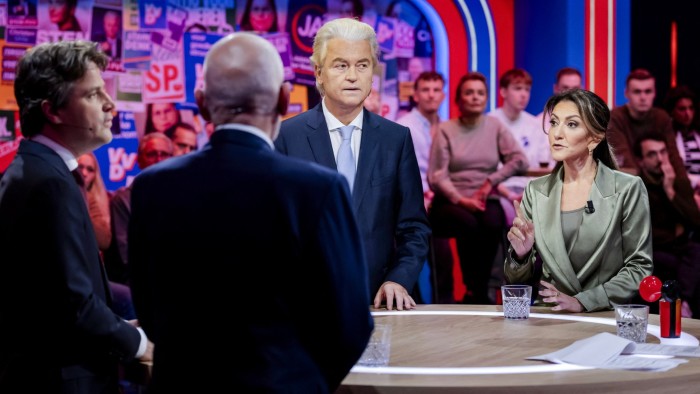
Dutch voters are expected to swing back to the centre in elections this week, after a two-year experiment with a government led by the far right ended in disarray.
The Freedom party (PVV) led by anti-Islam firebrand Geert Wilders swept to power in 2023 and is likely to top the polls again on Wednesday. But after a PVV-led coalition fell apart in June, two mainstream parties have pledged to block it from joining any future government.
The conservative Christian Democrats (CDA) and the centre-left Greens-Labour, who opted to stay in opposition, are tied for second place in opinion polls, with each hoping to secure the premiership.
“It’s too close to call,” said Sarah de Lange, a political-science professor at the University of Amsterdam. “But voters are looking for some stability after the chaos.”
After Geert Wilders was deemed too extreme to become prime minister — and stepped aside to allow other parties to form a coalition with his PVV — voters now face a choice between two conventional figures.
One is Labour leader Frans Timmermans, 64, a former European commissioner and Dutch foreign minister who has merged his Labour party with the Greens to strengthen their electoral chances.
The other is the untested Henri Bontenbal. The 42-year-old Christian Democrat only entered politics four years ago and polls show he is the people’s pick as prime minister. Reserved and hard-working, the churchgoing father of two has lived in Rotterdam all his life.
De Lange described the CDA leader as a throwback to the stolid premiership of Jan Peter Balkenende, who led the country from 2002 to 2010. Bontenbal “is seen as a reliable, decent person who will lead a stable coalition that will last more than a couple of years”.
The Freedom party is polling at around 20 per cent of voting intentions, followed by the CDA and Greens-Labour at 15 per cent, according to a poll of polls by Tom Louwerse of the University of Leiden.
But stable coalitions are hard to find. The lower house of the Dutch parliament has 150 seats and 15 parties routinely make the 0.67 per cent threshold required to become an MP. They range from the pro-immigrant party Denk to the Russophile far-right Forum for Democracy.
Among the eclectic field is a party for the over-50s and one for animal rights that recently split over European defence spending — those who opposed more expenditure formed a new Peace for Animals party.
New parties often perform well. In 2024, the centre-right New Social Contract — a CDA offshoot — came fourth with 19 seats. The populist Farmer Citizen Movement won eight, and both entered government with the Freedom party and a fourth partner, the right-wing liberal VVD.
They blocked Wilders from becoming prime minister but backed his pick — Dick Schoof, a former intelligence chief with no political experience. Schoof struggled to broker compromises between the fractious coalition members.
In June Wilders pulled his party out of the coalition after partners rejected his 10-point migration plan, which called for deploying the army to patrol borders, shutting refugee centres and repatriating many Syrian refugees.
Elections were called and soon after the NSC also pulled out over political differences. It might not win any seats this time, and the farmers’ party is projected to get only three.
D66, a progressive Liberal party led by former climate minister Rob Jetten, is polling between 14 and 19. The VVD, whose former leader Mark Rutte ran the country from 2010-23 before becoming Nato secretary-general, is down at 12-16.
After two years of haphazard policies and fights with the EU, it is no wonder voters want a rest, said Tom Berendsen, leader of the CDA in the European parliament. He attributed his party’s revival to the years spent in opposition and a pivot back to its roots, after receiving a historic drubbing in the 2023 elections.
“We have problems that for the last two years the government did not solve because they were fighting each other,” said Berendsen.
Bontenbal, a former energy consultant, focuses on competent administration and bottom up solutions, empowering people to improve their neighbourhoods and societies.
“In Bontenbal people are looking for stability, a decent style of politics, respectful debate,” Berendsen said.
Still, around 50 per cent of voters say they are undecided.
De Lange said there are two possible coalitions. One is a largely centrist grouping of Greens-Labour, CDA, D66 and potentially the VVD.
The other is a more rightwing alliance between Christian Democrats, VVD, D66, the farmers’ party and JA21, a populist upstart forecast to get around 12 seats. Talks could take many months.
The three big challenges — a lack of affordable housing, the cost of healthcare, and dealing with immigration — are all blamed on asylum seekers by many voters. Even Timmermans wants to cap arrival numbers and several parties support more forceful deportations of migrants.
If Timmermans becomes prime minister, the former EU climate tsar would be one of just five Socialist leaders in the 27-nation bloc, which has pivoted to the right on immigration, deregulation and reduced climate ambition.
“It’s quite tragic,” said a veteran Dutch official in Brussels. “He went back to the Netherlands finding it was no longer the country he left behind. If he comes back to the European summit arena he will find that Brussels has changed too.”
Read the full article here